

IEEE Indonesia Section implemented a structured Humanitarian and Community Engagement Program as an integrated disaster response initiative in Aceh Tamiang and North Sumatra Province, specifically in Tapanuli Tengah and Langkat. The program was conceived as a technology driven intervention aimed at restoring access to safe and reliable water sources for communities affected by flooding and disaster related infrastructure damage. Rather than limiting support to financial assistance, IEEE Indonesia Section adopted a comprehensive approach that combined fundraising, technical design, engineering implementation, monitoring, and direct field engagement to ensure measurable and sustainable impact.
The fundraising campaign began in mid January 2026 and concluded with a total collection of Rp113,000,000 (USD 6,726). Of this amount, Rp45,000,000 (USD 2,679) was allocated directly by IEEE Indonesia Section, while Rp68,000,000 (USD 4,048) was contributed collectively by IEEE chapters and individual donors. The participating chapters included the Communication Society Chapter; Circuits and Systems Society Chapter CAS04 CH10358; IEEE Indonesia MTT AP Joint Chapter; Joint Chapter Instrumentation and Measurement IM09 and Information Theory IT12 CH10929; Joint Chapter Vehicular Technology VT06 and Intelligent Transportation Systems ITS38 CH10930; Power and Energy Society Chapter; AES GRSS Chapter; Systems, Man, and Cybernetics Chapter; Consumer Technology Society Indonesia Chapter; CSS RAS Joint Chapter; and Electron Device Society Chapter. This cross chapter mobilization reflects a strong institutional commitment and coordinated professional solidarity within IEEE Indonesia Section. The total funds were fully allocated across three primary intervention areas, with clear delineation of technical outputs and financial accountability.
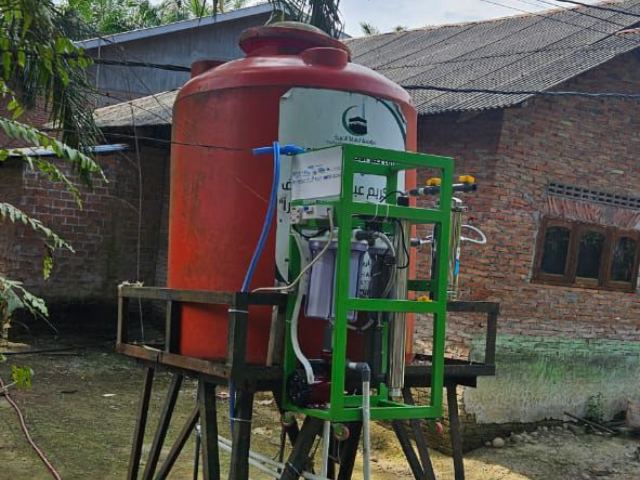
Ultrafiltration water treatment unit installed in Langkat, North Sumatra
In Aceh Tamiang, a total allocation of Rp74,500,000 (USD 4,435) was dedicated to the construction of two drilled bore wells. Each well was drilled to a depth of 50 meters to ensure access to a stable and sustainable aquifer layer. The decision to drill to 50 meters was based on the need to secure reliable groundwater beyond shallow contaminated layers, particularly in post disaster conditions where surface and near surface water sources were compromised. The scope of work included borehole drilling, casing installation, pump integration, piping system setup, and preparation for operational use. These two deep wells were designed to serve community scale needs, providing long term clean water access and strengthening resilience against future water scarcity or contamination.
In North Sumatra Province, interventions were implemented in two districts with distinct technical solutions aligned to local conditions. In Tapanuli Tengah, Rp22,500,000 (USD 1,339) was allocated for the construction of three drilled wells across three separate locations. The wells were constructed with depths of 11 meters and 13 meters, based on localized hydrogeological conditions and groundwater availability assessments. These wells were intended to restore functional water access for educational institutions and community facilities affected by flooding. The implementation included bore drilling, installation of well pipes, and integration with distribution components to ensure immediate usability. The three well installations collectively addressed urgent clean water needs while maintaining cost efficiency and technical feasibility within the allocated budget.
In Langkat, Rp15,000,000 (USD 893) from IEEE Indonesia Section was allocated for the installation of two ultrafiltration water pump systems at two different water source points. The filtration systems deployed were UF membrane units with a processing capacity of 1000 liters per hour and a membrane density of 0.01 micron. Each system incorporated a 5 micron cartridge pre filter to improve feed water quality prior to membrane filtration. The pump system required an initial electrical power of 286 watts and an operational power of 125 watts, ensuring manageable energy consumption for community use. The filtration unit dimensions measured approximately 40 by 25 by 90 centimeters, allowing compact yet robust installation. The systems were designed to convert turbid or contaminated water into safe water suitable for daily consumption at a household scale. Supporting infrastructure, including water storage components, was integrated to enable continuous and practical distribution for residents.
Field deployment was conducted on 30 and 31 January 2026, during which volunteers directly supervised installation, verified technical specifications, and ensured that each system was fully operational prior to handover. Activities included site visits, coordination with local stakeholders, monitoring of drilling progress and filtration system fabrication, validation of installation standards, and confirmation of system functionality. This on site presence ensured transparency, technical quality control, and direct engagement with beneficiaries.
The volunteer team consisted of both Executive Committee members and chapter representatives, demonstrating institutional leadership and chapter level accountability. The team included Dr. Kurnianingsih from Politeknik Negeri Semarang; Mera Kartika Damayanti, Ph.D from Politeknik Negeri Jakarta, serving as an Executive Committee member of IEEE Indonesia Section; Dr. Dian Retno Sawitri from Universitas Dian Nuswantoro, representing the Power and Energy Society Chapter; Prof. Dr. Ing Wahyudi Hasbi from BRIN, representing the AES GRSS Chapter; Dr. Muhammad Ary Murti from Telkom University, representing the Communication Society Chapter; Muhammad Nasrun from Telkom University, representing the Communication Society Chapter; Laily Ade Oktaviana from Telkom University, representing the Communication Society Chapter; and Ramzy Andriman, PhD from Universitas Syiah Kuala, representing the Systems, Man, and Cybernetics Chapter. Dr. Kurnianingsih, as part of the IEEE Indonesia Section Executive Committee, contributed to coordination and oversight of the overall initiative. Several volunteers financed their travel and field engagement independently, reflecting a strong professional and personal commitment to humanitarian service.
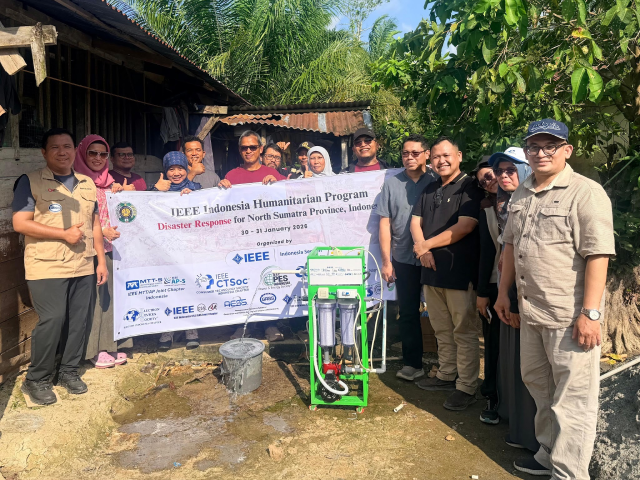
Official handover of the water filtration system to the local community in Langkat, North Sumatra
All collected funds have been fully disbursed and translated into tangible infrastructure outputs. The Rp113,000,000 (USD 6,726) mobilized under this initiative resulted in the construction of five drilled wells with depths ranging from 11 meters to 50 meters and the installation of two ultrafiltration based water pump systems. Through structured planning, technical rigor, cross chapter collaboration, and direct field supervision, IEEE Indonesia Section delivered accountable, sustainable, and engineering based disaster response interventions that provide immediate and long term benefits to affected communities in Aceh and North Sumatra.